Why the Best Version of Your Public Self Is Built Somewhere Nobody's Watching
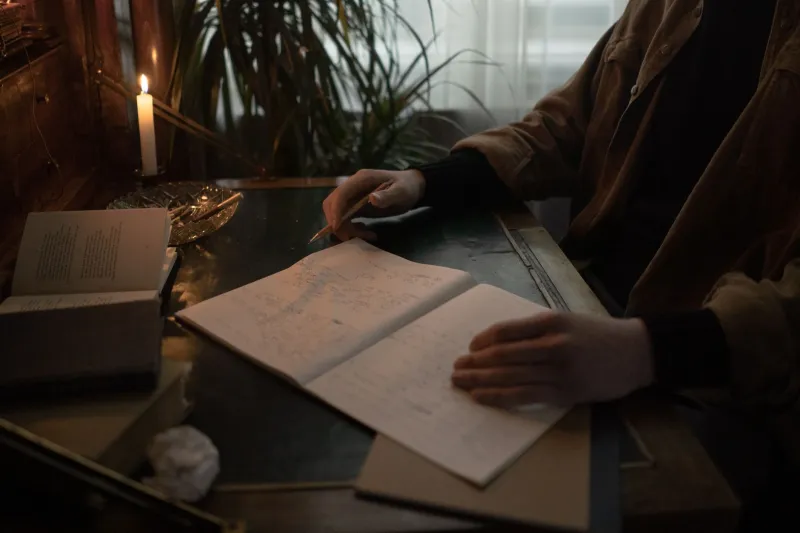
Here's something nobody's putting in their Instagram caption: the most compelling creators you follow probably have a whole practice that you've never seen. A notebook that's embarrassing. A voice memo folder full of half-baked ideas. A sketchbook that would make zero sense out of context. And that's exactly why their public work hits different.
We've been sold this idea that visibility equals validity — that if you're not posting, you're falling behind. But there's a growing body of evidence (and a whole lot of burned-out creators) suggesting the opposite might be true. The 'always-on' approach doesn't just exhaust you. It actually degrades the quality of what you're putting out there.
So let's talk about the paradox: why building in private might be the most strategic thing you can do for your public presence.
The Audience Effect Is Real — And It's Not Always Good
There's a concept in psychology called the audience effect — the idea that being observed changes how we perform a task. For simple, well-practiced skills, an audience can boost performance. But for complex, creative, or exploratory work? The presence of observers tends to make us more conservative, more self-conscious, and less willing to take risks.
Think about what that means for your creative process. When every brainstorm is a potential story, every rough draft a possible post, every failure a data point someone else might see — you start optimizing for approval before you've even figured out what you actually want to say. You edit before you've even started. That's not creativity. That's performance anxiety dressed up as content strategy.
The creators who consistently produce work that feels alive and specific and them — they've usually built a firewall between their experimental space and their public one. They're not sharing the clay. They're sharing the sculpture.
What 'Building in Private' Actually Looks Like
This isn't about being secretive or precious. It's about protecting the messy, generative part of the process from the pressure of an audience — even a small one.
For some people, that looks like a physical journal that never gets photographed. For others, it's a private Notion workspace, a voice memo habit, a weekly writing session that never gets turned into content. Some creators block off entire days — or even weeks — where they're deliberately off the grid, consuming and experimenting without any intention to produce something shareable.
The specifics matter less than the principle: you need a space where you can be genuinely bad at something while you're learning it. Where you can change your mind without having to walk anything back publicly. Where you can follow a weird thread just to see where it goes, without worrying about whether it'll make sense to your audience.
That's where your actual voice gets built. Not in the polished posts. In the stuff nobody sees.
The Burnout Nobody Talks About
There's a particular kind of exhaustion that comes from performing constantly — and it's different from regular creative fatigue. Regular fatigue happens when you've worked hard. This other kind happens when you've been on for too long, when the boundary between making something and presenting something has completely dissolved.
A lot of creators hit this wall and assume they've run out of ideas, or that they're not cut out for this, or that the algorithm has just made things too hard. But often, what's actually happened is that they've spent so long creating for an audience that they've lost touch with why they started creating in the first place. The internal compass got drowned out by external feedback.
Protected private time isn't a luxury. It's maintenance. It's how you stay connected to the part of yourself that has something genuine to say, instead of just the part that knows how to say things in ways that perform well.
Strategic Invisibility as a Creative Tool
Here's where it gets interesting: disappearing on purpose — even briefly — can actually amplify your public presence when you come back. Not because absence creates mystique (though sometimes it does), but because you return with something real. You've been somewhere. You've thought about something. You have actual material instead of just content.
Some of the most respected voices in any creative field are known for going quiet between projects. They're not constantly feeding the machine. They're filling back up. And when they resurface, there's a quality and intentionality to what they share that's immediately noticeable.
You don't have to be famous for this to work. Even at a smaller scale, audiences can feel the difference between someone who's sharing because they have something to say versus someone who's sharing because they haven't posted in four days and they're panicking.
How to Actually Build This Into Your Life
If the 'always-on' model is what you've been running on, shifting to something more intentional takes some deliberate structure. A few things that actually work:
Protect at least one creative session per week that has no output goal. You're not producing content. You're exploring. Let it be weird and unfinished.
Create a 'not for sharing' folder — physical or digital — where raw ideas live without pressure. Give yourself permission to let some of them stay there forever.
Build in regular offline windows — even just a few hours — where you're consuming, experiencing, or thinking without documenting. Go to a museum. Take a walk without your phone. Read a book you'll never reference publicly.
Notice when you're creating for the response versus creating because you're genuinely compelled. That internal check matters. When the answer is always 'for the response,' something's off.
The Work That Happens Before the Work
The public-facing version of any creator is the tip of an iceberg. What makes it compelling is everything underneath — the years of private practice, the failed experiments, the ideas that didn't go anywhere but taught you something anyway, the slow accumulation of perspective that you can't fake and you can't rush.
You can't manufacture depth by posting more. You build it by doing the unglamorous, invisible work of actually developing your craft and your thinking in spaces where no one's watching.
So yeah — log off sometimes. Close the laptop. Fill the notebook with stuff you'll never share. That's not wasted time. That's the whole foundation.
The audience gets the best of you when you've spent some serious time being your most unpolished, uncertain, genuinely curious self — somewhere they can't see.